My Partners in School

This page provides teachers with research-based articles and helpful resources to support their instructional decisions. The content has been divided into the following sections:
- Bilingual Education in the U.S.
- Parent’s Involvement
- Special Education
- Culturally and Linguistically Sustainable Pedagogy
- Instructional Resources
- Models, Methods, and Strategies to Teach Emergent Bilinguals
- Bilingual Education Entities
- Teaching Resources
Our emergent bilinguals’ parents, especially the ones new to our school system, need to be informed about how the ESOL program works, their children’s rights as bilingual learners, and how they can get involved and advocate for their children’s bilingual education. Feel free to reproduce this packet, if you consider it might be useful to your EBs’ parents.
Suggestions are welcomed!Download
Bilingual Education in the U.S.

Bilingual Education, Reviving an American Tradition
Our country’s legacy when it comes to bilingual education.
SALA (Student Achievement through Language Acquisition)
Portal that provides supplemental professional development for teachers of language learners.
Parents’ Involvement
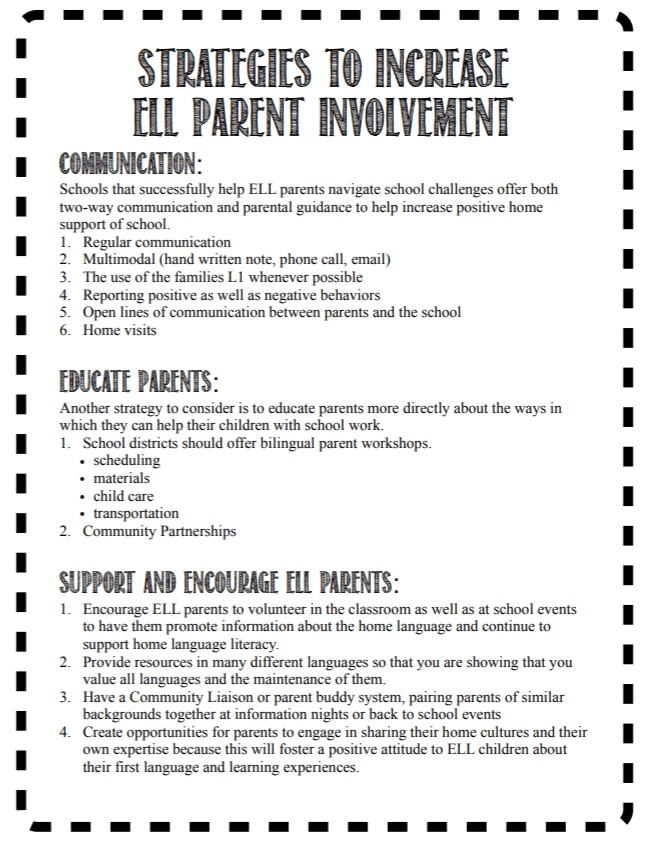

Engaging parents as partners and advocates is imperative for their children’s academic sucess.Download
Engaging ELL Families: 20 Strategies for School Leaders
School leaders and teachers should make ELL success a priority; to create a culture of respect for ELLs and their families; to allocate resources on their behalf; to empower their staff to become teacher leaders; to encourage the staff to keep trying creative approaches; to lead the community in creating a school-wide action plan for engaging ELL families.
This study’s results revealed that Hispanic parents’ involvement has a positive impact on their children’s academic performance, and that teachers’ empowerment has a negative impact when primarily focused on professional knowledge attainment only.Download
Increasing Emergent Bilinguals’ Parent Involvement.
This article describes the stories of two parents and compares their experiences with schools, their personal views of literacy, and how the home environment might support school literacy and academic success.Download
Educators need to understand the barriers that hinder some parents from participating in their children’s education.Download
Special Education
Challenges in Special Education Identification for ELLs
Watch Dr. Alba Ortiz, one of the nation’s leading experts on questions of special education for English language learners (ELLs), discussing the challenges related to special education identification.
Culturally and Linguistically Sustainable Pedagogy
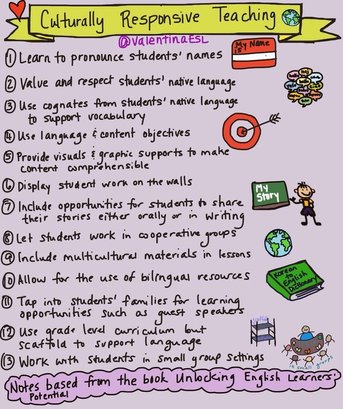
“In this article, the authors identify a small set of principles that can serve as the linguistic foundation for the teaching of English language learners in mainstream classes. The authors then outline linguistically responsive pedagogical practices that flow directly from those principles. They conclude with concrete suggestions for how teacher education programs can incorporate the knowledge and skills that will prepare all pre-service teachers to be linguistically responsive.”Download
Culture influences the context and may be considered either a threat or an opportunity. This article shows how context can contribute to teaching and learning of culture.Download
“By providing structured opportunities to practice oral language skills (both academic and content vocabulary) with partners and in small groups, teachers help increase English learner’s oral use of academic language, which in turn deepens learning.”Download
This article looks at race from the perspective of a public commodity that the society “funds” in order to make it seem real and intractable. The challenge in a society that so “fully funds”race is it seems near impossible to “defund” the concept in teacher education to allow new teachers to approach the classroom as a space where race is not determinant and highly predictive of student achievement.Download
Instructional Resources
The Bloom’s Taxonomy is a hierarchical ordering of cognitive skills that can help teachers teach and students learn. It is also a framework to plan assessment.
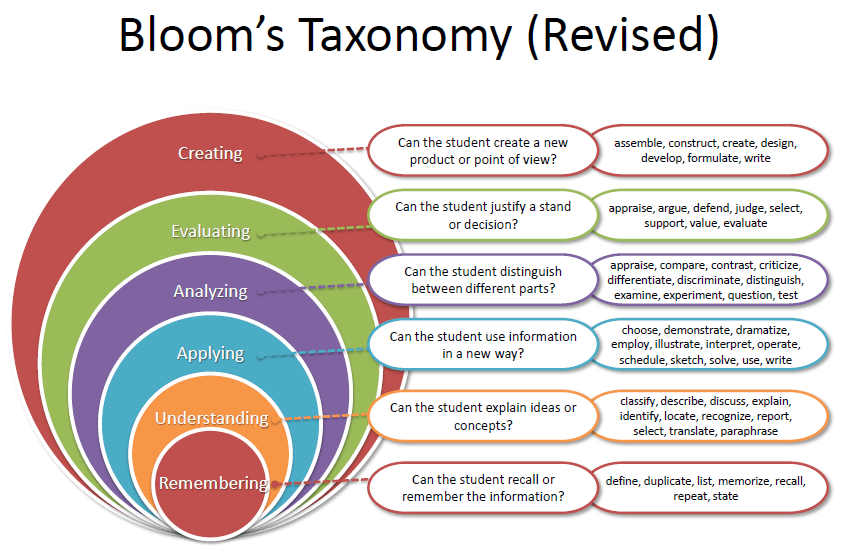
Bloom’s Taxonomy in Distance Learning
Watch a video of a teacher explaining what Bloom’s Taxonomy is and how to implement it in class to ensure the instruction goals are met.
THIS ARTICLE IS PURE GOLD! The authors identify a small set of principles that can serve as the linguistic foundation for the teaching of English language learners in mainstream classes. Also, linguistically responsive pedagogical practices are outlined.Download
The use of data is a crucial component in personalized learning, which ensures that student learning experiences— what they learn and how, when, and where they learn it—are tailored to their individual needs, skills, and interests and enable them to take ownership of their learning. Personalized learning is critical to meeting all students where they are, so they are neither bored with assignments that are too easy nor overwhelmed by work that is too hard.Download
Models, Methods, and Strategies to Teach Emergent Bilinguals
Visual Thinking Strategy
Using Photos with English-Language Learners
Using photos with emergent bilinguals can be enormously effective in helping them learn far more than a thousand words — and how to use them. Explore the strategies that Mr. Larry Ferlazzo suggests to support EBs with their English vocabulary acquisition through observation and analysis of images.
“The teaching-learning cycle is based on the notion of having high expectations supported by strong scaffolding and explicit teaching. It is based on Vygotskian principles of learning through interaction with more proficient others in the context of shared experience. The activities are carefully ordered to build up students’ knowledge and abilities so that they can experience success.”
– Prof. Beverly Derewianka
University of Wollongong
Culturally Responsive Teaching – Biography-Driven Instruction
Developed by Dr. Socorro Herrera, BDI is an effective model part of a culturally responsive teaching approach. It focuses on eliciting our students’ background knowledge and use it as building blocks to teach our EB students.
The flipped classroom has been recognized by educators as an innovative and effective instructional approach. The seamless flipped learning model is proposed by integrating the features of mobile and wireless communication technologies into the flipped classroom model to provide a guide for researchers and educators to develop effective flipped learning
activities and plans for helping students learn seamlessly across contexts.Download
Bilingual Education Entities

WIDA develops and provides proven tools and support to help multilingual learners, and their educators, succeed.

Formerly Teachers of English to Speakers of Other Languages, is the largest professional organization for teachers of English as a second or foreign language.
Our mission is to help teachers and schools educate children and youth to be active participants in a diverse democracy. Teaching Tolerance provides free resources to educators—teachers, administrators, counselors and other practitioners—who work with children from kindergarten through high school.
NABE – National Association for Bilingual Education
A non-profit membership organization that works to advocate for educational equity and academic excellence for bilingual/multilingual students in a global society.
CAL – Center for Applied Linguistics
A nonprofit organization promoting access, equity and mutual understanding for linguistically and culturally diverse people around the world.
National center dedicated to improving education outcomes for all children, especially those with disabilities birth through age twenty-one, through the use of effective evidence-based practices and interventions.
Teaching Resources
TV411 is a rich source of multimedia teaching materials that combine streaming videos with related interactive web lessons on reading, writing, math, science, and financial literacy. You can use these materials to supplement your students literacy curriculum, create new lessons, and enable students to practice their skills on their own.
Helpful Online Resources for Teaching ELLs
Websites and teacher-created videos make content more accessible for English language learners—whether they’re in the classroom or at home, by Laurel Schwartz.
This free website provides hundreds of reading passages for students in grades 5th through 12th. Each passage includes comprehension questions, aligned with the Common Core State Standards, and related media. The goal is to support students with the reading, writing, communication, and problem-solving skills they need to be successful in college and beyond.

ReadWorks is a website that provides plenty of reading passages and lesson plans for students of all levels K-12. Their goal is support students to improve reading comprehension by bringing the latest in literacy teaching research into the classroom.

Find here short, award-winning animated videos about ideas that spark the curiosity of learners everywhere. It also provides video-based lessons and articles to make your class more engaging, meaningful, entertaining, and effective.
 Growing Bilinguals